
Sustainability
Sustainable Flowers, a Lighter Footprint
Around half our fresh stems are imported. We buy at market every one to three days, build against orders we've already taken, and let you choose a colour instead of a flower — so very little is thrown away.
How Sustainable Are We, Really?
Here is the honest version, with our own numbers rather than an industry statistic borrowed from somebody else. We are a single studio in Leeds. We buy fresh stems at wholesale markets every one to three days rather than holding stock, which keeps the range wide and the flowers young. Around 50% of those stems are imported, and the exact split moves week to week with what people ask us for. We buy against orders we have already taken, so what comes back from market usually already has somebody's name on it. And on our mystery bouquets — where you choose the colour palette and we choose the stems — waste drops to near zero, because nothing is bought speculatively and nothing gets rejected for failing to match a brief.
Two things we are not going to dress up. Our packaging is paper and twine wherever the flowers allow, plus a protective film sleeve where they don't — and that sleeve is plastic. And we do use floral foam where a design needs the mechanics, working without it wherever the design allows. Both are explained further down rather than quietly left out.
Every 1–3 days
How often we buy at wholesale market
Little and often, so the range stays wide and the stems stay young. Buying weekly would mean buying more than we need.
Around 50%
Share of our fresh stems that are imported
It moves week to week with what customers actually ask for. We'd rather publish the real number than imply a supply chain we don't have.
Order-led
We buy against confirmed orders
Not into stock. The flowers we carry back from market already have somebody's name on them.
Near zero
Waste on a mystery bouquet
You choose the colour palette; we choose the stems. Nothing is bought speculatively and nothing is rejected for not matching a brief.
Our Commitments
Small choices that add up — from the market bench to your doorstep.
Seasonal Fresh Blooms
We buy at wholesale market every one to three days rather than holding stock, so we build with what looked best that morning. Seasonal stems need less forcing, freight and refrigeration — and they last longer in the vase.
Paper, Twine & a Plastic Sleeve
Paper and twine wherever the flowers allow — that's the eco-friendly part, and it's most of the parcel. Where a bloom needs protecting we add a florist film sleeve. It's polypropylene, so we make no green claim for it.
Minimal Waste
We order against confirmed orders, not in bulk on spec. What's left over goes into mystery bouquets and studio pieces, where a beautiful stem in the right palette is always welcome.
Local Delivery
Fresh flowers are hand-delivered by us across Leeds and West Yorkshire, priced by road distance. Nothing fresh that we sell is flown or posted to a customer.
Long-Lasting Alternatives
Hand-crocheted flowers are bought once and kept: 3+ years — indefinite with proper care. Preserved arrangements, launching soon, are real blooms that keep for 3+ years — longer with proper care.
Made with Intention
Every arrangement is made to order. No mass production, no shelf stock, and no skip of unsold bouquets at the end of the week.
Mystery Bouquets Are Our Strongest Green Credential
A mystery bouquet is the one thing we sell where the florist, not the customer, picks the flowers. You choose the colour palette and the size; we build the bouquet from whatever is freshest and most beautiful in the studio that day. Most people read that as a nice surprise, and it is. It is also the single most effective piece of waste control a small florist has.
Here is why. An order for a named variety commits us to buying that specific flower on a specific day, whether or not the market has good ones that morning. If the good ones are gone, the options are a compromised stem, an awkward substitution conversation, or buying more than we need to find enough decent ones. An order for a colour commits us to nothing but the palette. Anything genuinely beautiful in that palette can go in — so nothing is bought speculatively, and no perfectly good stem sits in a bucket because it failed to match somebody's brief.
It works the other way too: the stems most at risk of being thrown away are the perfectly good ones nobody happened to ask for by name, and a mystery bouquet is exactly where those get used first. So while it is sold as a surprise and priced as good value, ordering one is quietly the greenest thing you can buy from us. It is available fresh for Leeds and West Yorkshire, and as a crochet bouquet shipped UK-wide.
Around Half Our Stems Are Imported
That figure is ours, not an industry average, and we are not going to bury it. Roughly 50% of the fresh stems we buy have travelled to reach the market we buy them from; the rest have not. The split is not a policy — it moves with the season and with what customers actually order. A February order for roses and a June order for garden-grown looking stems produce very different weeks.
What we can control is how much we buy and how little of it is wasted. Buying every one to three days rather than weekly means we are never sitting on stock we bought on a guess. Buying against orders we have already taken means most of what we carry back is already spoken for. As a small, independent Leeds florist, that is where our leverage genuinely is — not in a claim about where the flowers were grown.
We will not pretend to be perfect. We would rather publish the real number and show you what we do about it.
Packaging and Floral Foam, Without the Spin
These are the two things florist sustainability pages tend to skate over, so here they are plainly.
Packaging
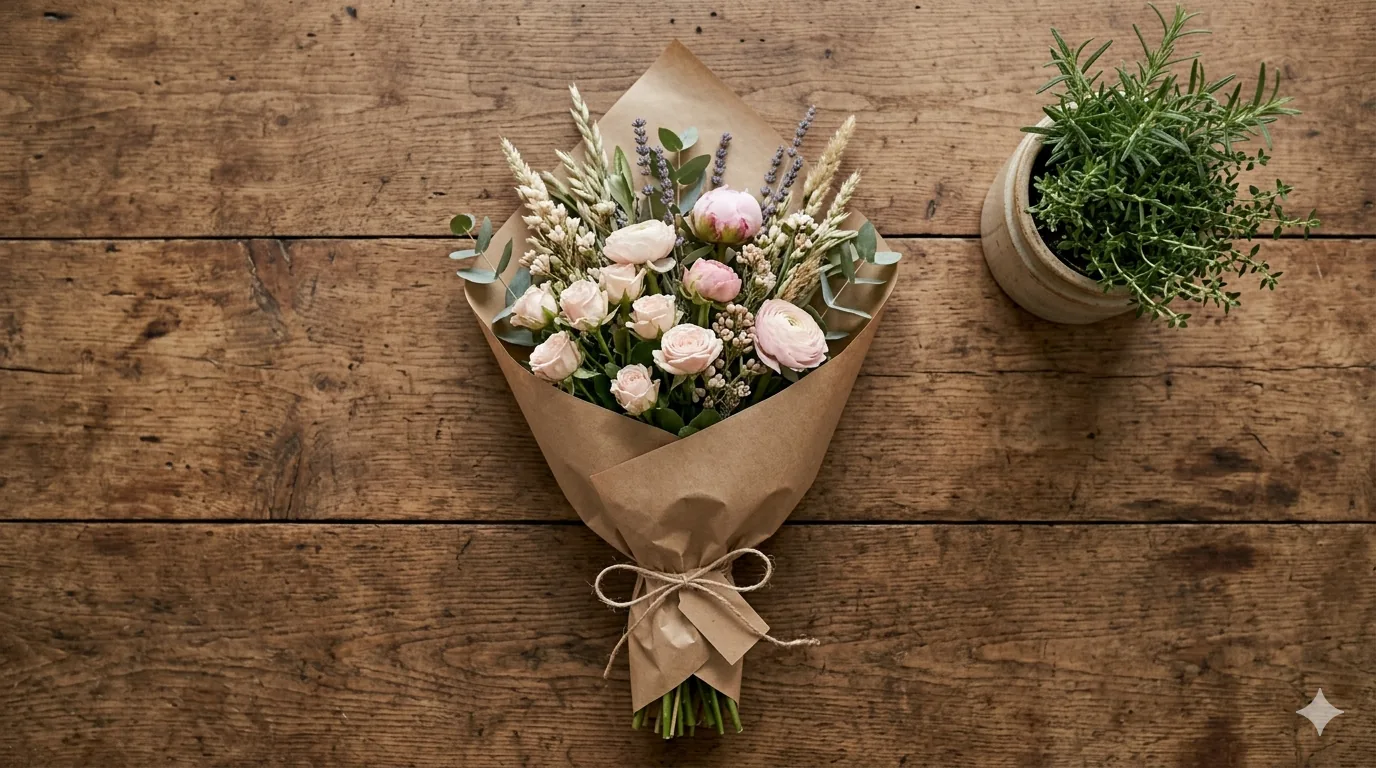
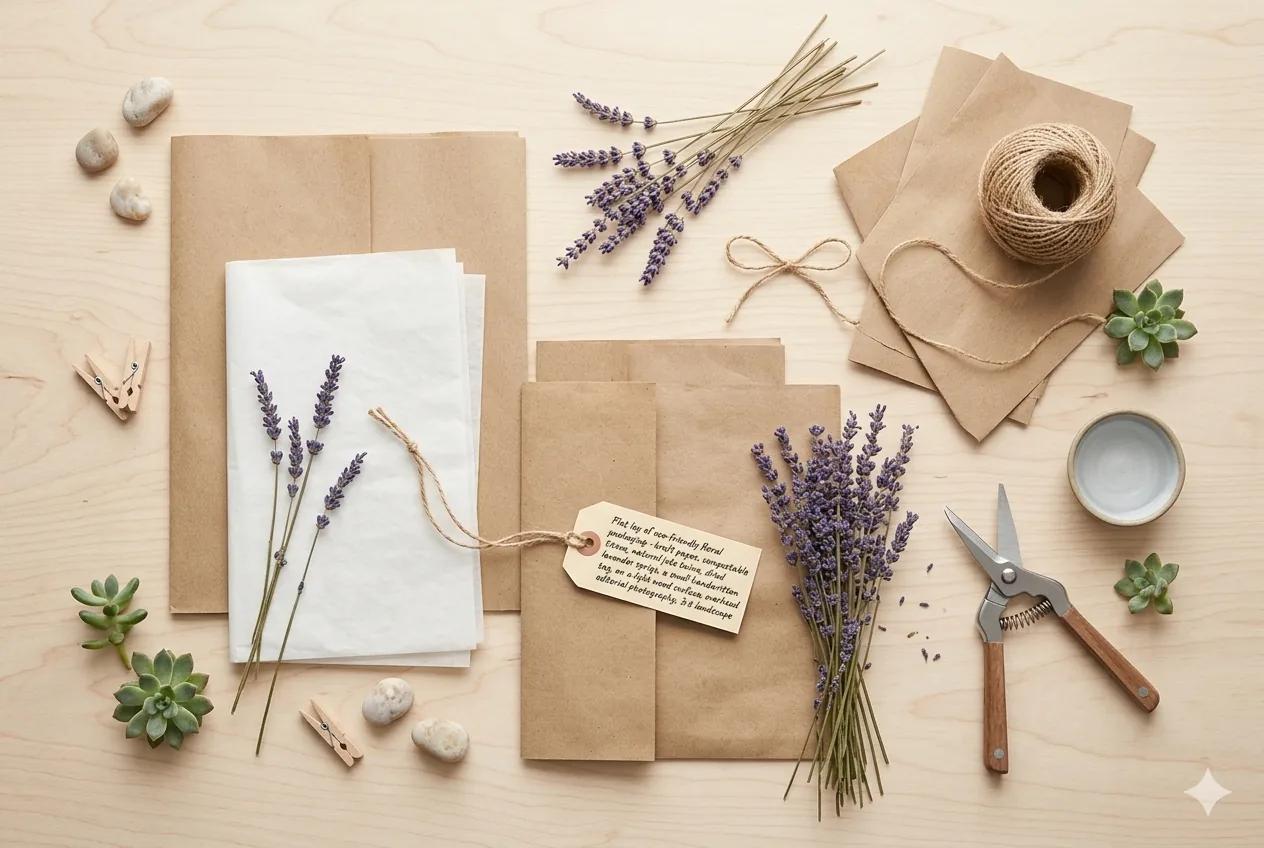
Your flowers are wrapped in paper and finished with twine wherever the flowers allow. That is the eco-friendly part of the parcel and it is most of it. Where a bloom needs protecting on the journey, we add a clear florist film sleeve.
That sleeve is standard florist film — polypropylene, which is to say plastic. It is not the compostable cellulose that shares the name “cellophane” in everyday speech, and we are not going to call it recyclable either until we can point you at a collection that will genuinely take it. It is there because it stops flowers arriving crushed, and we use it only where it earns that.
Floral foam
We do use floral foam, depending on the design. Plenty of what we make needs none of it — a hand-tied bouquet, a vase arrangement, most of what leaves the studio — and we build those without it as a matter of course.
Other designs rely on it for the mechanics. Foam is what holds a stem at an angle, in place, hydrated, in a shape that survives a car journey, and we have not found one substitute that does all four in a boxed arrangement. An arrangement that collapses in transit is not a green choice either. So the position is: no foam wherever the design allows it, foam where the design needs it, and no pretending in between. There is more on this on our blog.
What Sustainable Floristry Looks Like Day to Day
Sustainability in a flower studio is not one grand gesture — it is dozens of small, unglamorous decisions, most of them made at a market at an unsociable hour. Buying every one to three days instead of once a week means smaller baskets and fresher stems, and it means we never have to guess a fortnight ahead of demand. Buying against confirmed orders means the arithmetic is simple: what you order is broadly what we buy. Seasonal choices then do the quiet heavy lifting, because a flower in its natural season simply needs less — less forcing, less freight, less refrigeration — and it rewards you by lasting longer in the vase.
Our longest-lasting answer to flower waste, though, is the keepsake work. A crochet bouquet is one gift, made once, kept for 3+ years — indefinite with proper care — and our preserved range, launching soon, will keep for 3+ years — longer with proper care. The most sustainable flowers are the ones nobody throws away. And when fresh is the right answer — it very often is — paper wrapping, a delivery radius we can drive ourselves and a bouquet built from what was best that morning keep the footprint where it belongs: small, and honestly described.
How You Can Help
Sustainability isn't just on us — here are three simple ways you can make a real difference too.
Choose the colour, not the flower
Ordering a mystery bouquet lets us build from what is genuinely best that morning. It is better value for you and it is the single biggest thing you can do to cut waste on our side.
Consider a keepsake
Crocheted flowers are bought once and kept, and our preserved range is launching soon. A gift that never needs replacing is a gift whose footprint is paid only once.
Make them last
Trim the stems, change the water, keep them out of direct sun. A bouquet that lasts twelve days instead of six halves its footprint without a single supply chain changing.
Sustainability Questions, Answered
The four we get asked most — answered from how we actually buy, not from a brochure.
Are imported flowers bad for the environment?
Not automatically, and the answer surprises most people. Freight is only one part of a flower's footprint and often not the biggest — how the flower was GROWN usually matters more. A rose grown outdoors in East African sunlight and flown over in the hold of a passenger plane can carry a smaller footprint than the same rose grown a few hundred miles away in a glasshouse heated through a British February. What is unambiguously wasteful is buying flowers nobody wants and throwing them away, which is why our effort goes into ordering against confirmed orders rather than into the flag on the box. For the record: around half the stems we buy are imported.
Are British-grown flowers actually greener?
In season, usually yes — a stem grown in a field a couple of hours away skips the flight entirely. Out of season it is much less clear, because the same stem then needs heat and artificial light to exist at all, and heating a glasshouse through winter is expensive in carbon as well as money. The season matters more than the border. We buy at wholesale market every one to three days and take the best of what is genuinely good that morning, so our mix shifts with the year rather than following a rule; around 50% of it is imported and we would rather tell you that plainly than market a supply chain we do not have.
What do you do with unsold stock?
We hold very little of it, by design. Buying at market every one to three days against orders we have already taken means we are not filling buckets on Friday and hoping somebody walks past before Monday — the classic florist's waste problem barely arises here. What is left over goes into mystery bouquets and studio pieces, because those customers chose a colour palette rather than a named variety, so any beautiful stem in that palette qualifies. That is precisely why mystery bouquets matter to us: they are where surplus goes to be enjoyed instead of binned.
Are preserved and crochet flowers more sustainable than fresh?
Per gift, measured over time, yes — because they are bought once. A hand-crocheted bouquet is cotton yarn worked by hand; it does not wilt, does not need replacing and keeps for 3+ years — indefinite with proper care, so its environmental cost is paid once rather than every couple of weeks. Preserved arrangements, launching soon, are real blooms treated to keep for 3+ years — longer with proper care. Neither is cost-free — yarn and preservation both have footprints of their own, and neither is compostable at the end. But the most sustainable flowers really are the ones nobody throws away, so if you want one thing that stays, a keepsake wins; if you want the ritual of fresh flowers arriving, fresh is honest and lovely and we would rather you enjoyed it than felt guilty about it.
Questions About Our Practices?
We're always happy to talk about how we buy, what we throw away, and what we haven't solved yet.
Read more about our studio, check our FAQ, see how delivery and collection work, or explore our gallery.